Showing posts with label Science and Technology. Show all posts

Sunday, February 13, 2011

Tecnalia develops a system for heat collection from asphalt pavements

Tecnalia, through its Construction Unit, is participating in the Pavener project, aimed at developing a system for collecting the solar energy absorbed by asphalt paved surfaces. The two-year project is being led by the Campezo Group. The Group is focusing on quality control and research project development through its Research and Quality Control Laboratory, and presently this is one of its key projects.
The system involves collecting solar energy accumulated in pavements by circulating a fluid through pipes installed below the surface. This method works similarly to a solar collector incorporated into the pavement. The system can be implemented below any paved surface exposed to solar radiation, such as roads, pavements, car parks, airport landing runways and aprons, etc. Asphalted paved surfaces can heat up 70 degrees in days of strong sunlight, and given the large paved surface area available, there is a great potential for the recovery of this energy.

Multiple applications

The system can be designed for multiple applications, the most novel of these being its use as a solar collector, with great potential in the building sector. Incorporating concepts such as heat storage and heat pumps into the developed system, the accumulated solar energy may be used in low-temperature applications such as the air-conditioning of buildings, sports and leisure centres, swimming pools, and hot water supply. Another potential application of the system is its use for maintaining the temperature of the asphalt above freezing levels in winter, thus preventing the formation of ice on the roads. Apart from the benefits to road safety, this would reduce the amount of salt needed to be used to prevent frost.
The system would reduce consumption of fossil fuels, as well as greenhouse gas emissions to the atmosphere, as a renewable source of energy is exploited. Moreover, the maintenance required for roads is reduced, as road surface temperature can be maintained stable both in winter and in summer, thus reducing the appearance of cracks and grooves in the paved surfaces. An additional advantage of the system is the reduction of the urban heat island effect, as excess heat is extracted from the paved surfaces.

Simulation tasks

The Construction Unit at Tecnalia is researching into the thermal and mechanical properties of the system through experimental simulations and measurements, with the goal of optimising the system configuration depending on the application. Structural stability and thermal behaviour are the key aspects to consider in the development of the system.
The performance of the system will be further studied after the construction of a prototype installation.

Bing Energy relocates to partner with FSU on high-tech fuel cells

Bing Energy relocates to partner with FSU on high-tech fuel cells

IMAGE: This is Professor Jim P. Zheng of Florida State University.

Click here for more information.
Florida Gov. Rick Scott today announced that Bing Energy Inc. of Chino, Calif., has selected Tallahassee as the new site of the company's world headquarters. The company, in collaboration with Professor Jim P. Zheng of The Florida State University, is planning to turn revolutionary nanotechnology pioneered at FSU into a better, faster, more economical and commercially viable fuel cell. The move is expected to create at least 244 jobs paying an average wage of $41,655 in Florida.
"I am proud to welcome Bing Energy and thank them for recognizing that Florida is the best state in the nation," Scott said. "As governor, I am continuing to make it the best place to do business. This is only the beginning. Just as Bing Energy was convinced to bring jobs here, I am talking to companies across the nation. I am letting them know that our reduction in the business tax burden, commitment to job creation, and Florida's world-class work force mean we are open for business."
Bing Energy, a manufacturer of state-of-the-art components for polymer electrolyte membrane fuel cells, will begin production in March 2011 and serve the domestic and international energy markets.
"We know that, with the continuing support of Gov. Scott, the Legislature and the people of Florida, our institutions of higher learning will continue to foster innovation, and jobs will continue to cluster around those innovations," said Florida State University President Eric J. Barron. "The breakthrough research by Drs. Wang and Zheng and the company's decision to come to Florida confirm that the investment made in their work by our state and the federal government has realized its commercial potential. Bing Energy represents the future, and Florida State is proud to be a part of it."
IMAGE: This is President Barron (foreground) and Florida Governor Rick Scott (background).

Bing is moving its global headquarters to Tallahassee to work in partnership with Zheng, who has pioneered a fuel cell that incorporates a thin membrane composed of carbon nanotubes, reducing the need for expensive platinum components that, until now, have made fuel cells too expensive to be widely marketed. Zheng's technology is based on pioneering research and development of buckypaper conducted at Florida State's High-Performance Materials Institute. The institute's director, Professor Ben Wang, is the assistant vice president for research at Florida State.
Bing Energy's innovation promises to produce a fuel cell that is more efficient, more durable and significantly less expensive – benefits that could transform the transportation and power generation sectors.
Joining Scott and Barron in celebrating Bing Energy's move to Tallahassee were Bing Energy CFO Dean Minardi, Tallahassee Mayor John Marks, and representatives from the Economic Development Council of Tallahassee/Leon County Inc.
"We all know the world's existing energy-use pattern is unsustainable," Minardi said. "A commercially viable fuel cell will transform the way we drive, reducing our dependence on fossil fuels. It will transform the way we deliver energy to neighborhoods, ensuring reliability and eliminating the risk of brownouts."
Bing Energy's move to Florida is tied to a $1.9 million award the company recently received from the Governor's Office of Tourism, Trade and Economic Development. The award is a Qualified Target Industry (QTI) Tax Refund in support of job creation. The local Tallahassee and Leon County governments are also supporting Bing Energy by each providing a 10 percent match on the QTI Award.
Gov. Scott has stated that creating jobs is his top priority. As governor, he has announced plans to create 700,000 jobs over the next seven years by implementing accountability budgeting, reducing government spending, enacting regulatory reform, focusing on job growth and retention, investing in world class state universities, reducing property taxes and phasing out the business income tax.
Local officials expressed delight that Tallahassee was chosen by Bing Energy as its relocation site.
"Our organization identified tax incentives and work-force training programs that gave Tallahassee the edge over other communities under consideration," said Kim Williams, chairman of the Economic Development Council of Tallahassee/ Leon County Inc. "This is a perfect example of why connecting industry, education and government is so important. In this case, these connections helped us to retain our talent, as well as our university technologies and commercialization within our community."
Tallahassee Mayor John Marks spoke of the importance of creating jobs in his community and "retaining one of our greatest assets, our work-force talent. The city of Tallahassee is committed to doing our part to help this promising company establish its roots in our community."
Marks' comments were echoed by John Dailey, chairman of the Leon County Commission.
"The county is committed to working with our public and private sectors, especially our universities, to help businesses locate in our community," Dailey said.
###
Additional information on the Bing Energy-FSU licensing agreement is available at http://www.fsu.com/News/FSU-signs-licensing-agreement-with-technology-company-Bing-Energy.

New IEEE-USA president looks to advance US innovation and entrepreneurship

New IEEE-USA President Ron Jensen has identified advancing U.S. innovation, entrepreneurship and competitiveness as his priorities for 2011.
"Engineers and technologists are innovators and job creators," Jensen said. "The more technology specialists we unleash in the workforce, the better our opportunity to revitalize the U.S. economy. Our nation's ability to innovate new products and services will help us to compete globally and create jobs in the United States."
Jensen, who became IEEE-USA president on 1 January, succeeds Evelyn Hirt. Jim Howard is president-elect.
Jensen is encouraged by the recently announced public/private partnership, Startup America, and its potential to increase the number of new businesses that have high-growth, high job-creating potential. See http://www.whitehouse.gov/issues/startup-america.
IEEE-USA supports and promotes high-tech entrepreneurship through programs like its Entrepreneurs Village, TechMatch and IEEE Alliance of Consultants Networks. In 2009, IEEE-USA entered into a partnership with the Small Business Administration to assist high-tech entrepreneurs starting new ventures. Federal and state resources are available at http://www.ieeeusa.org/careers/entrepreneurs/resources.asp#SBA.
"I am especially interested in understanding how we can help our members become more innovative, entrepreneurial and competitive in the global economy," Jensen said. "We have to understand what our members' careers will be like 5 to 10 years from now and support their adjustment to that environment."
IEEE-USA will also work with other science and engineering organizations to encourage Congress to fund the America COMPETES Reauthorization Act of 2010. The legislation, which was signed into law in December, authorizes federal investment in science, engineering, innovation, technology and competitiveness. Its goal is to help the United States maintain its world technology leadership and to create jobs.
###
Meet the New IEEE-USA President Ronald G. Jensen enjoyed a 40-year career with IBM. He held positions in semiconductor development and applications, chip development, system design, systems architecture, management and project management. He assisted in the development of several IBM families of computers and servers, and retired in 2009 as a chief engineering manager.
Jensen's professional interests range from systems architecture and embedded systems to technical education, management and strategic planning, to the use of the Internet, collaboration tools and social networking to build a professional environment.
Jensen became a student IEEE member in 1972, a member three years later and a senior member in 1999. He also holds membership in Eta Kappa Nu, the electrical and computer engineering honor society, and the Project Management Institute.
Jensen has held numerous IEEE volunteer leadership positions. Highlights include, among others, serving on the IEEE Board of Directors as Region 4 director in 2005-06, and chairing the IEEE Strategic Planning Committee in 2007-08. He is a member of the IEEE Computer Society, Technology Management Council and Women in Engineering affinity group. He was honored with an IEEE Third Millennium Medal in 2000.
Jensen and his wife, Marlene, live on Lake Zumbro outside of Rochester, Minn. They have two grown sons, Joel and Ryan, and three grandchildren, Emily, Lily and Dane.
For more on Jensen, check out the December issue of IEEE-USA In Action: http://www.nxtbook.com/nxtbooks/ieeeusa/ieeeusa_1210/#/22/OnePage.
IEEE-USA advances the public good and promotes the careers and public policy interests of 210,000 engineering, computing and technology professionals who are U.S. members of IEEE. http://www.ieeeusa.org

Saturday, February 12, 2011

In online dating, blacks more open to romancing whites than vice versa


New research from the University of California, Berkeley, suggests that when it comes to dating, cyberspace is as segregated as the real world. Data gathered from more than 1 million profiles of singles looking for love online show that whites overwhelmingly prefer to date members of their own race, while blacks, especially men, are far more likely to cross the race barrier in hopes of being struck by Cupid’s arrow.
UC Berkeley researchers analyzed the racial preferences and online activity of people from the United States who subscribed between 2009 and 2010 to a major Internet dating service. In their profiles, the online daters stated a racial preference. Some said they preferred to date only within their race, others preferred someone outside their race, and yet others said they were open to dating someone of any race.
Researchers were then able to compare the online daters’ stated preferences with whom they actually contacted for a date, and they found profound differences between blacks and whites.
“Those who said they were indifferent to the race of a partner were most likely to be young, male and black,” said Gerald Mendelsohn, a UC Berkeley psychologist, professor of graduate studies and lead author of the study, which will soon be submitted for publication.
Overall, he said, “Whites more than blacks, women more than men and old more than young participants stated a preference for a partner of the same race,”
The reluctance of whites to contact blacks was true even for those who claimed they were indifferent to race.  More than 80 percent of the whites contacted whites and fewer than 5 percent of them contacted blacks, a disparity that held for young as well as for older participants.
“Were they hypocritical? Alert to the realities of the social world? Striving for political correctness? Attempting an optimizing strategy of self-presentation? Our data do not permit us to choose among those alternatives,” the study authors wrote.
The study’s coauthors are Lindsay Shaw Taylor, a postdoctoral researcher at UC Berkeley; Andrew T. Fiore, a graduate of the UC Berkeley School of Information who is currently a visiting assistant professor at Michigan State University and Coye Cheshire, an assistant professor in the School of Information.
An estimated one in five Americans has used an online dating service such as eHarmony or  Match.com, and a growing number of urbanites are finding romance via Facebook and other social networking sites. The percentage of couples who have met online is now nearly equal to that of pairs who met through friends or family, according to the researchers.
“As the use of online dating services grows, people whose paths never would have crossed offline now regularly meet and have meaningful exchanges in the virtual world,” the UC Berkeley study says.
The last 40 years have seen a dramatic shift in attitudes in America toward black-white intermarriage – from three to one opposed to three to one in favor, said Mendelsohn. Yet, 2000 U.S. Census data shows that black-white couples represent just 1 percent of American marriages, he said.
The main findings of this study parallel the census data on marriage in that blacks are more likely than whites to be in interracial marriages, and that couples in which the husband is black and the wife is white are more common than those in which the husband is white and the wife is black, according to Mendelsohn.
“One theory is that blacks are acting like other minority populations in the history of this country,” Mendelsohn said. “They are interested in moving up in the power structure, and one way you do that is through intermarriage with the dominant group.”
According to the study, more than 80 percent of the online dating contacts initiated by whites were to other whites, with only 3 percent going to blacks. This trend held for both men and women, young and old. Although black participants initiated contact to members of their own race more than to whites, they were ten times more likely to contact whites than vice versa, according the the study.
The researchers also tracked the rates of reciprocation among the pool of online daters, looking at how they responded once they received a message from an interested potential partner. Again, white men and women were most likely to respond to members of their own race, and only 5 percent of their responses went to blacks.
A major objective of the study was to gauge how changing attitudes about interracial marriage and an increase in dating opportunities have played out in relationships between blacks and whites. Also of interest to researchers was the question of whether the Obama presidency signals that the United States has entered a post-racial era.
“It is clear that we are not yet in the post-racial era, and evidence from studies of online dating suggest that waiting for its arrival will take some patience,” the study concludes.


Web experts ask scientists to use the Web to improve understanding, sharing of their data in science

Troy, N.Y. – Peter Fox and James Hendler of Rensselaer Polytechnic Institute are calling for scientists to take a few tips from the users of the World Wide Web when presenting their data to the public and other scientists in the Feb. 11 issue of Science magazine. Fox and Hendler, both professors within the Tetherless World Research Constellation at Rensselaer, outline a new vision for the visualization of scientific data in a perspective piece titled "Changing the Equation on Scientific Data Visualization."
As the researchers explain, visualizations provide a means to enable the understanding of complex data. The problem with the current use of visualization in the scientific community, according to Fox and Hendler, is that when visualizations are actually included by scientists, they are often an end product of research used to simply illustrate the results and are inconsistently incorporated into the entire scientific process. Their visualizations are also static and cannot be easily updated or modified when new information arises.
And as scientists create more and more data with more powerful computing systems, their ability to develop useful visualizations of that data will become more time consuming and expensive with the traditional approaches.
Fox and Hendler ask the scientific community to take some important lessons from the Web.
"…visualizations on the Web are becoming increasingly more sophisticated and interactive," they write. At the same time, those Web-based visualization are also inexpensive and easy to use, according to Hendler and Fox.
Simple Web-based visualization tool kits allow users to easily create maps, charts, graphs, word clouds, and other custom visualizations at little to no cost and with a few clicks of a mouse. In addition, Web links and RSS feeds allow visualizations on the Web to be updated with little to no involvement from the original developer of the visualization, greatly reducing the time and cost of the effort, but also keeping it dynamic.
"Visualizations are absolutely critical to our ability to process complex data and to build better intuitions as to what is happening around us," the researchers write. They use the example of an online weather report. With such visualizations, Web users can click on their area for a forecast or watch videos specific to their region. Without these visualizations, no one but a trained meteorologist would be able to make sense of the mess of raw data behind those pretty maps and graphical snow clouds.
In addition to the ease of using and developing visualization on the Web, visualizations on the Web can also be easily modified, updated, customized, and recreated by other users thanks to the use of Uniform Resource Identifiers. This "linking" of data is a key feature of the new vision that Fox and Hendler outline. It is of particular importance when dealing with what they refer to as "big science" on topics such as climate change that involves data that ranges from distinct fields like biology to geology.
"The challenge is that many of the major scientific problems facing our world are becoming critically linked to the interdependence and interrelatedness of data from multiple instruments, fields, and sources," they write.
Fox and Hendler urge scientists involved in such vital scientific projects to take some tips from large Web companies like Google and Facebook, and even massive online communities such as World of Warcraft. These large companies use new data integration approach such as NoSQL, "big data," and scalable linked data to rapidly expand and maintain their capabilities. These new capabilities provide easy-to-use, low-end tools to generate visualizations and scalable tools for curating very large visualization projects that scientists can model their own visualization after, according to Fox and Hendler.
###
For more information on the research of Fox and Hendler as well as the Tetherless World Research Constellation go to http://tw.rpi.edu/.

Thursday, August 14, 2008

Yale University : 'Cosmic ghost' discovered by volunteer astronomer


Hanny's Voorwerp and IC 2497.


When Yale astrophysicist Kevin Schawinski and his colleagues at Oxford University enlisted public support in cataloguing galaxies, they never envisioned the strange object Hanny van Arkel found in archived images of the night sky.

The Dutch school teacher, a volunteer in the Galaxy Zoo project that allows members of the public to take part in astronomy research online, discovered a mysterious and unique object some observers are calling a "cosmic ghost."

van Arkel came across the image of a strange, gaseous object with a hole in the center while using the www.galaxyzoo.org website to classify images of galaxies.

When she posted about the image that quickly became known as "Hanny's Voorwerp" ( Dutch for "object") on the Galaxy Zoo forum, astronomers who run the site began to investigate and soon realized van Arkel might have found a new class of astronomical object.

"At first, we had no idea what it was. It could have been in our solar system, or at the edge of the universe," said Schawinski, a member and co-founder of the Galaxy Zoo team.

Scientists working at telescopes around the world and with satellites in space were asked to take a look at the mysterious Voorwerp. "What we saw was really a mystery," said Schawinski. "The Voorwerp didn't contain any stars." Rather, it was made entirely of gas so hot — about 10,000 Celsius — that the astronomers felt it had to be illuminated by something powerful. They will soon use the Hubble Space Telescope to get a closer look.

Since there was no obvious source at hand in the Voorwerp itself, the team looked to find the source of illumination around the Voorwerp, and soon turned to the nearby galaxy IC 2497.

"We think that in the recent past the galaxy IC 2497 hosted an enormously bright quasar," Schawinski explains. "Because of the vast scale of the galaxy and the Voorwerp, light from that past still lights up the nearby Voorwerp even though the quasar shut down sometime in the past 100,000 years, and the galaxy's black hole itself has gone quiet."

"From the point of view of the Voorwerp, the galaxy looks as bright as it would have before the black hole turned off – it's this light echo that has been frozen in time for us to observe," said Chris Lintott, a co-organizer of Galaxy Zoo at Oxford University, UK. "It's rather like examining the scene of a crime where, although we can't see them, we know the culprit must be lurking somewhere nearby in the shadows." Similar light echoes have been seen around supernovae that exploded decades or centuries ago.

Quasars are very unusual, highly luminous objects, powered by supermassive black holes, and most are extremely distant. "The strange 'Hanny's Voorwerp' looks like it could be the nearest example of a luminous quasar," said C. Megan Urry, Israel Munson Professor of Physics & Astronomy and Chair of the Physics Department at Yale, who was not involved in the research.

"IC 2497 is so close that if the quasar was still shining today, on a good night you could probably see it with a small telescope," Schawinski added. "The nearest active quasar, called 3C 273, is 1.7 billion light years further away."

"This discovery really shows how citizen science has come of age in the Internet world," commented Professor Bill Keel of the University of Alabama, a galaxyzoo.org team member. "Hanny's attentiveness alerted us not only to a peculiar object, but to a window into the cosmic past which might have eluded us for a long time otherwise. Trying to understand the processes operating here has proven to be a fascinating challenge, involving a whole range of astrophysical techniques and instruments around the world and beyond. This has also been some of the most rewarding astronomy I've done in years!"

The Galaxy Zoo project was imagined and begun by Schawinski and his colleague Chris Lintott at Oxford. While working on his PhD thesis, Schawinski classified and catalogued nearly 50,000 galaxies. Knowing that the human eye is sometimes more sensitive than a computer at picking out unusual patterns, he mused that it would be wonderful if there were amateur astronomers who were interested in doing some of the "scanning."

"When we launched Galaxy Zoo we were overwhelmed — as was the internet portal, initially — with the outpouring of public interest and volunteer input," said Schawinski. During the last year, over 150,000 armchair astronomers from all over the world volunteered their time and submitted over 50 million classifications for a set of one million images online. They then could follow the progress of the science they made possible at www.galaxyzooblog.org .

"It's amazing to think that this object has been sitting in the archives for decades and that amateur volunteers can help by spotting things like this online," said Hanny van Arkel. "It was a fantastic present to find out on my 25th birthday that we will get observational time on the Hubble Space Telescope to follow-up this discovery."

The next stage of Galaxy Zoo will ask volunteers to search for more unusual astronomical objects. But, "Hanny's Voorwerp" remains a mystery. It's huge central hole is over 16,000 light years across and Galaxy Zoo astronomers are still puzzling over what caused it.

###

The new digital images used in Galaxy Zoo were taken using the robotic Sloan Digital Sky Survey telescope in New Mexico. More on the Sloan Digital Sky Survey is at www.sdss.org . For full details of those involved see www.sdss.org/collaboration/credits.html.

Besides Schawinski, the Galaxy Zoo team includes scientists from the University of Oxford, the University of Portsmouth and Johns Hopkins University (USA), and Fingerprint Digital Media of Belfast. Key contributors to this stage of the project were Chris Lintott from the University of Oxford, Bill Keel from the University of Alabama (USA), Dan Smith (Liverpool John Moores University) Matt Jarvis (University of Hertfordshire) and Nicola Bennert (University of California Riverside, USA). The team's observations and analysis are included in a paper which has been submitted to the Monthly Notices of the Royal Astronomical Society, the UK's leading astronomical journal. For more information, visit www.galaxyzoo.org

Images related to the project can be downloaded from http://www.ox.ac.uk/media/news_releases_for_journalists/gzvimages.html. A netcast interview with Kevin Schawinski is available on iTunesU in the Science section and on the Yale Public Affairs site at http://feeds.feedburner.com/yale/science.

Friday, July 25, 2008

Rensselaer Polytechnic Institute Study suggests human visual system could make powerful computer


To actually get your visual system to carry out this computation requires "perceptually walking through the circuit " from the inputs downward to the output.


Since the idea of using DNA to create faster, smaller, and more powerful computers originated in 1994, scientists have been scrambling to develop successful ways to use genetic code for computation. Now, new research from a professor at Rensselaer Polytechnic Institute suggests that if we want to carry out artificial computations, all we have to do is literally look around.

Assistant Professor of Cognitive Science Mark Changizi has begun to develop a technique to turn our eyes and visual system into a programmable computer. His findings are reported in the latest issue of the journal Perception.

Harnessing the computing power of our visual system, according to Changizi, requires visually representing a computer program in such a way that when an individual views the representation, the visual system naturally carries out the computation and generates a perception.


Examples of visual wire alone; and with inputs one, to indicate a tilt toward the viewer; and 0, to indicate a tilt away.

Ideally, we would be able to glance at a complex visual stimulus (the software program), and our visual system (the hardware) would automatically and effortlessly generate a perception, which would inform us of the output of the computation, Changizi said.

Changizi has begun successfully applying his approach by developing visual representations of digital circuits. A large and important class of computations used in calculators, computers, phones, and most of today's electronic products, digital circuits are constructed from assemblies of logic gates, and always have an output value of zero or one.

"A digital circuit needs wire in order to transmit signals to different parts of the circuit. The 'wire' in a visual representation of a digital circuit is part of the drawing itself, which can be perceived only in two ways," said Changizi, who created visual stimuli to elicit perceptions of an object tilted toward (an output of one) or away (an output of zero) from the viewer. "An input to a digital circuit is a zero or one. Similarly, an input to a visual version of the circuit is an unambiguous cue to the tilt at that part of the circuit."

Changizi used simple drawings of unambiguous boxes as inputs for his visually represented digital circuits. The positioning and shading of each box indicates which direction the image is tilted.

He also created visual representations of the logic gates NOT, which flips a circuit's state from 0 to 1 or vice versa; OR, which outputs 1 if one or both inputs are 1; and AND, which outputs 1 only if both inputs are 1.

"Visually represented NOT gates flip a box's perceived tilt as you work through a circuit, and OR gates are designed with transparency cues so that the elicited perception is always that the box is tilted toward you, unless overridden," Changizi said. "The AND gate is similarly designed with transparency cues, but contrary to the OR gate, it will always favor the perception that it is tilted away from you."

By perceptually walking through Changizi's visual representation of a digital circuit, from the inputs downward to the output, our visual system will naturally carry out the computation so that the "output" of the circuit is the way we perceive the final box to tilt, and thus a one or zero.

"Not only may our visual system one day give DNA computation a run for its money, but visual circuits have many potential advantages for teaching logic," Changizi said. "People are notoriously poor logical reasoners — someday visual circuits may enable logic-poor individuals to 'see their way' through complex logical formulae."

Although Changizi's visual stimuli are successful at eliciting viewer perception, he says there are still serious difficulties to overcome. The visual logic gates do not always transmit the appropriate perception at the output, and it can be difficult to perceive one's way through these visual circuits, although Changizi argues we may have to train our visual system to work through them, similar to the way we need to be taught to read.

Additionally, building larger circuits will require smaller or more specialized visual circuit components.

"My hope is that other perception and illusion experts will think of novel visual components which serve to mimic some digital circuit component, thereby enriching the powers of visual circuits," Changizi said.

###

About Rensselaer

Rensselaer Polytechnic Institute, founded in 1824, is the nation's oldest technological university. The university offers bachelor's, master's, and doctoral degrees in engineering, the sciences, information technology, architecture, management, and the humanities and social sciences. Institute programs serve undergraduates, graduate students, and working professionals around the world. Rensselaer faculty are known for pre-eminence in research conducted in a wide range of fields, with particular emphasis in biotechnology, nanotechnology, information technology, and the media arts and technology. The Institute is well known for its success in the transfer of technology from the laboratory to the marketplace so that new discoveries and inventions benefit human life, protect the environment, and strengthen economic development.

Purdue University researcher Find 'Nanonet' circuits closer to making flexible electronics reality


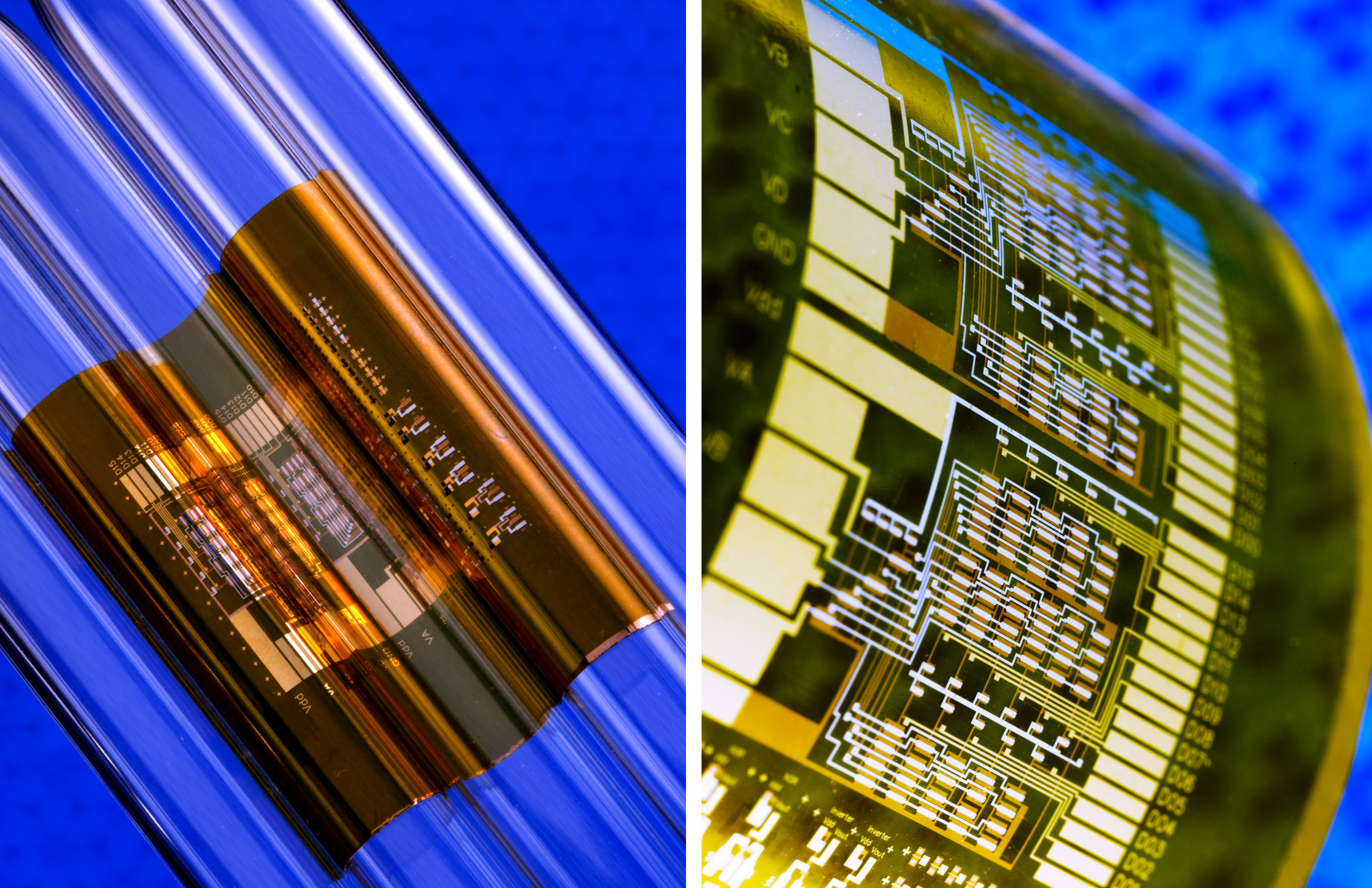
These are two photos of flexible circuits created using carbon nanotubes in research at Purdue University and the University of Illinois at Urbana-Champaign. The researchers have overcome a major obstacle...

Researchers have overcome a major obstacle in producing transistors from networks of carbon nanotubes, a technology that could make it possible to print circuits on plastic sheets for applications including flexible displays and an electronic skin to cover an entire aircraft to monitor crack formation.

The so-called "nanonet" technology - circuits made of numerous carbon nanotubes randomly overlapping in a fishnet-like structure - has been plagued by a critical flaw: The network is contaminated with metallic nanotubes that cause short circuits.

The discovery solves this problem by cutting the nanonet into strips, preventing short circuits by breaking the path of metallic nanotubes.

"This is a fundamental advance in how nanotube circuits are made," said Ashraf Alam, a professor of electrical and computer engineering at Purdue University. He is working with Kaushik Roy, Purdue's Roscoe H. George Professor of Electrical and Computer Engineering, and doctoral students Ninad Pimparkar and Jaydeep P. Kulkarni.

Researchers at the University of Illinois at Urbana-Champaign led experimental laboratory research to build the circuits, and Purdue led research to develop and use simulations and mathematical models needed to design the circuits and to interpret and analyze data.

Findings will be detailed in a research paper appearing in the journal Nature on July 24. The paper was written by the Purdue engineers and University of Illinois researchers : John A. Rogers, Founder Professor of Materials Science and Engineering and a professor of chemistry; Moonsub Shim, Racheff Assistant Professor of Materials Science and Engineering; and doctoral students Qing Cao, Hoon-sik Kim and Congjun Wang.

"These findings represent the culmination of four years of collaborative efforts between the Illinois and Purdue groups," Rogers said. "The work established the fundamental scientific knowledge that led to this particular breakthrough and the ability to make circuits."

The nanonets are made of tiny semiconducting cylinders called single walled carbon nanotubes. Metallic nanotubes form unavoidably during the process of making carbon nanotubes. These metal tubes then link together in meandering threads that eventually stretch across the width of the transistor, causing a short circuit.

"Other researchers have proposed eliminating the metallic nanotubes," Rogers said. "Instead, we found a very nice way of essentially removing the effect of these metallic nanotubes without actually eliminating them."

The researchers created a flexible circuit containing more than 100 transistors, the largest nanonet ever produced and the first demonstration of a working nanonet circuit, Alam said.

"Now there is no fundamental reason why we couldn't develop nanonet technologies," he said. "If you can make a flexible circuit with 100 transistors, you can make circuits with 10,000 or more transistors."

The advance may allow researchers to use carbon nanotube transistors to create high-performance, shock-resistant, lightweight and flexible integrated circuits at low cost, Alam said.

A key advantage of the nanonet technology is that it can be produced at low temperatures, enabling the transistors to be placed on flexible plastic sheets that would melt under the high temperatures required to manufacture silicon-based transistors, he said.

Possible applications include an electronic skin that covers an aircraft and automatically monitors the formation of cracks to alert technicians and prevent catastrophic failures.

Such shape-conforming electronics are not possible using conventional silicon-based circuits, which are manufactured on rigid wafers or glass plates.

"Now electronics are flat, which limits their utility since most objects in real life are not flat," Roy said.

Flexible displays could be integrated into automotive windshields to provide information for drivers. Other potential applications include "electronic paper" that displays text and images, solar cells that could be printed on plastic sheets and television screens capable of being rolled up for transport and storage.

"For these types of applications, manufacturers might literally print, or stamp, circuits onto plastic sheets, like the roll-to-roll printing used to print newspapers," Alam said.

Conventional circuits for flat-panel televisions contain transistors made of materials called polysilicon or amorphous silicon, which cannot be used in flexible applications.

Nanonet transistors are promising for so-called macroelectronics because they are best suited for large-scale applications, but these transistors may not be as well suited for the requirements of microelectronic circuits, such as those in computer chips, Alam said.

The nanotubes are arranged randomly and overlap each other like tiny needles. If the nanonet area is large enough, the overlapping metallic nanotubes will eventually form a meandering string across the entire transistor, causing a short circuit. But if the device is segmented into strips, this meandering path of metallic rods is cut at the point where the lines separate one strip from another, preventing short circuits.

The metallic nanotubes make up about one-third of the nanotubes in the transistor. Because the carbon nanotubes are twice as numerous as the metallic tubes, enough of them exist to form a complete circuit. The models and simulations are needed to tell researchers precisely how wide to make the strips so that the pathway of metallic tubes is cut but the carbon nanotubes complete their circuit.

"The theory and simulation work done at Purdue shows there is always a way to break the metallic path and still keep the semi conducting carbon-nanotube path intact," Alam said. "The teams at Illinois and Purdue continuously provide insights about why things work the way they do and how to make them work better through combined modeling and experimental efforts."

Each nanonet transistor consists of numerous strips of nanotubes, separated bylines that are etched in place. The lines are easy to create with a standard etching process used in the semiconductor industry.

Future research may include work focusing on learning the reliability of the carbon nanotube circuits.

The research has been funded by the National Science Foundation through the Network for Computational Nanotechnology at the Birck Nanotechnology Center in Purdue's Discovery Park. The Illinois portion of the research also was funded and supported by the NSF, U.S. Department of Energy, Motorola Corp., and by the university's Frederick Seitz Materials Research Lab, the Center for Microanalysis of Materials and the Department of Chemistry.

The researchers used computers made available by a global network called the nanoHUB, an Internet-based science gateway that provides computer-based resources for research and education in the areas of nanoelectronics and nanoelectromechanical systems and their application to nano-biosystems.

"This work requires tremendous computing resources because these are not trivial calculations," Alam said.

Nanoelectronics focuses on creating a class of electronic devices containing features measured in nanometers, equivalent to one-billionth of a meter. A nanometer is about the size of 10 atoms strung together.

The Network for Computational Nanotechnology uses advanced theory and simulations to explore new ideas for digital switching devices such as innovative types of transistors that promise to help researchers create future electronics.

###

The research is complementary to work by Purdue researcher David Janes, a professor of electrical and computer engineering. His work involves transparent circuits using a different type device called nanowires, made of indium oxide instead of carbon nanotubes.

Related Web sites:

Purdue University Home Page: http://www.purdue.edu
Birck Nanotechnology Center: http://www.nano.purdue.edu
Network for Computational Nanotechnology: http://www.ncn.purdue.edu/
Discovery Park: http://purdue.edu/discoverypark
National Science Foundation: http://www.nsf.gov/

PHOTO CAPTION:

These are two photos of flexible circuits created using carbon nanotubes in research at Purdue University and the University of Illinois at Urbana-Champaign. The researchers have overcome a major obstacle in producing transistors from networks of carbon nanotubes, a technology that could make it possible to print circuits on plastic sheets for applications including flexible displays and an electronic skin to cover an entire aircraft to monitor crack formation. (University of Illinois at Urbana-Champaign)

A publication-quality photo is available at http://news.uns.purdue.edu/images/+2008/nanotube-flexcircuits.jpg

Abstract on the research in this release is available at: http://news.uns.purdue.edu/x/2008b/080723AlamFlexible.html

Tuesday, July 22, 2008

Public Library of Science Says WikiPathways gives the people the power to curate


The exponential growth of diverse types of biological data presents the research community with an unprecedented challenge to keep the flood of biological data as accessible, up-to-date, and integrated as possible. But it also presents an unprecedented opportunity to cultivate new models of data curation and exchange by engaging the direct participation of the community. In a new article published this week in PLoS Biology, "WikiPathways: Pathway Editing for the People," Alexander R. Pico and his colleagues describe their efforts to embrace that opportunity and meet the challenge of collecting and curating vast amounts of biological information on cellular pathways.

Pathways are critical to understanding the functions of individual genes and proteins in the context of the systems and processes that contribute both to normal physiology and to disease. Each biological pathway must be constructed from a mass of biological information distributed across multiple publications and databases. The researchers argue that their resource, WikiPathways, which combines a wiki-based pathway curation resource with an embedded graphical pathway editing tool, can meet the growing challenge presented by the influx of biological data, and provides an innovative example of content curation by the biology community. The new resource, which allows users to view, store, and edit biological pathway information, is completely free and open source.

Curating and archiving information on biological pathways present a special challenge because pathways comprise a myriad of interactions, reactions, and regulations, which are often identified piecemeal over extended periods and by a variety of researchers. Efforts to take on this challenge have typically relied on small groups of paid curators. Given the "Herculean task" of curating "all of biology," the researchers established WikiPathways to draw on the collective expertise of the scientific community to facilitate content collection and curation. Just as Wikipedia and other innovative creative support tools have changed how we access, collect and manage information, WikiPathways presents a new, collaborative model for thinking about biological pathway information, they argue. The resource attempts to harness the power of the community to not only organize and maintain the vast amounts of biological data but also to maximize its value by providing the community with a wealth of annotated information.

"WikiPathways will be a powerful resource for the research community and a vital forum for pathway curation," the authors argue. "And we are hopeful that it will serve as an example for how the continuing flood of biological data can be managed and utilized by the community to irrigate future hypotheses and discoveries."

###

Citation:Pico AR, Kelder T, van Iersel MP, Hanspers K, Conklin BR, et al. (2008) WikiPathways: Pathway editing for the people. PLoS Biol 6(7): e184.doi:10.1371/journal.pbio.0060184

PLEASE ADD THE LINK TO THE PUBLISHED ARTICLE IN ONLINE VERSIONS OF YOUR REPORT: http://biology.plosjournals.org/perlserv/?request=get-document&doi=10.1371/journal.pbio.0060184

PRESS ONLY PREVIEW OF THE ARTICLE: http://www.plos.org/press/plbi-06-07-pico.pdf

CONTACT:
The Gladstone Institutes
Department of Cardiovascular Disease
San Francisco, CA 94158
+1-415-734-2741
+1-415-355-0960 (fax)
apico@gladstone.ucsf.edu

American Roentgen Ray Society : iTunes allows radiologists to save, sort and search personal learning files

iTunes has the ability to manage and organize PDF files just as easy as music files, allowing radiologists to better organize their personal files of articles and images, according to a recent study conducted by researchers at Renji Hospital and Shanghai Jiaotong University School of Medicine in Shanghai, China.

"Most published medical papers are available on the internet in a PDF format now," said Li Jun Qian, MD, lead author of the study. "For radiologists, these electronic papers provide richer information (e.g. various cases, reviews and abundant, valuable images) than conventional textbooks and can be easily found and downloaded for further reading via online databases. However, managing PDF files is troublesome and it is difficult to find software designed for organizing them," said Dr. Qian.

Generally speaking, most people sort PDF files in folders on their PC by topic. However, using this approach does not solve the issue of how to file multi-subject articles, said Dr. Qian The study authors found that iTunes can address this issue due to its powerful search and sort functions, its ability to remember a user's favorite articles and its capability to support customized shortcuts for different topics and/or categories.

"One day I just happened to drag and drop a PDF into iTunes and was surprised to find that it was supported by iTunes. This means that you can search, describe, and rate PDFs just like you do the music files," said Dr. Qian. "We no longer need to keep PDF files in redundant folders."

###

This study appears in the July issue of the American Journal of Roentgenology.

Ohio State University NEW PROJECT TO DEVELOP GPS-LIKE SYSTEM FOR MOON


The same Ohio State University researcher who is helping rovers navigate on Mars is leading a new effort to help humans navigate on the moon.

When NASA returns to the moon -- the space agency has set a target date of 2020 to do so -- astronauts won't be able to use a global positioning system (GPS) to find their way around, explained Ron Li, the Lowber B. Strange Designated Professor of civil and environmental engineering and geodetic science.

Ron Li

The moon doesn't have satellites to send GPS signals.

So NASA has awarded Li $1.2 million over the next three years to develop a navigation system that will feel a lot like GPS to the astronauts that use it, but will rely on signals from a set of sensors including lunar beacons, stereo cameras, and orbital imaging sensors.

Li described the project in a poster session Monday at the NLSI Lunar Science Conference, held at NASA Ames Research Center in Moffett Field, California.

The new grant grew out of Li's ongoing development of software for the Mars rovers Spirit and Opportunity. Researchers have learned a lot about navigation from exploring the red planet. New technology -- sensors, inertial navigation systems, cameras, computer processors, and image processors -- will make the next trip to the moon easier for astronauts.

People are used to having certain visual cues to judge distances, such as the size of a building or another car on the horizon, Li explained. But the moon has no such cues. Getting lost, or misjudging a distant object's size and location would be easy, and extremely dangerous.

He described incidents during past lunar missions when astronauts were traveling to a target site such as a crater, and got within a few yards of it -- but couldn't see the crater because of difficult terrain.

"They were so close, but they had to turn back for safety's sake," he said.


Keeping astronauts safe will be a top priority for Li's team, which includes experts in psychology and human-computer interaction as well as engineering.

"We will help with navigation, but also with astronauts' health as well," Li said. "We want them to avoid the stress of getting lost, or getting frustrated with the equipment. Lunar navigation isn't just a technology problem, it's also biomedical."

Li explained how the system will work: images taken from orbit will combine with images from the surface to create maps of lunar terrain; motion sensors on lunar vehicles and on the astronauts themselves will allow computers to calculate their locations; signals from lunar beacons, the lunar lander, and base stations will give astronauts a picture of their surroundings similar to what drivers see when using a GPS device on Earth. The researchers have named the entire system the Lunar Astronaut Spatial Orientation and Information System (LASOIS).

Li, who leads Ohio State's Mapping and Geographic Information Systems Laboratory, will work with Kaichang Di, a research scientist, and Alper Yilmaz, an assistant professor, both of civil and environmental engineering and geodetic science. Yilmaz works in the the university's Photogrammetric Computer Vision Laboratory.

LASOIS partners at NASA Glenn Research Center will convert a pre-existing communications beacon to do double-duty for communication and navigation. Massachusetts Institute of Technology researchers will design the touch-pad that astronauts will wear -- possibly on the arm of their space suits, Li said -- to view their location and search for new destinations. University of California, Berkeley, researchers will work out the visual cues that astronauts will need to find their way, and study the kinds of psychological stress they will experience.

According to Li's plan, the team will create a prototype navigation system, then travel to the Mojave Desert to test and refine it. The third year would possibly be spent testing the system on NASA astronauts.

NASA would then have several years to incorporate the navigation system into its other lunar technologies before 2020.

#

Contact: Ron Li, (614) 292-6946, Li.282@osu.edu

Written by Pam Frost Gorder, (614) 292-9475; Gorder.1@osu.edu

California Institute of Technology scientists offer new explanation for monsoon development


Geoscientists at the California Institute of Technology have come up with a new explanation for the formation of monsoons, proposing an overhaul of a theory about the cause of the seasonal pattern of heavy winds and rainfall that essentially had held firm for more than 300 years.

The traditional idea of monsoon formation was developed in 1686 by English astronomer and mathematician Edmond Halley, namesake of Halley's Comet. In Halley's model, monsoons are viewed as giant sea-breeze circulations, driven by the differences in heat capacities between land and ocean surfaces that, upon heating by sunlight, lead to temperature differences between warmer land and cooler ocean surfaces--for example, between the Indian subcontinent and the oceans surrounding it.

"These circulations form overturning cells, with air flowing across the equator toward the warmer land surface in the summer hemisphere, rising there, flowing back toward and across the equator aloft, and sinking in the winter hemisphere," explains Tapio Schneider, associate professor of environmental science and engineering at Caltech.

A different explanation is offered by Schneider and Simona Bordoni of the National Center for Atmospheric Research in Boulder, Colorado. The duo used a computer-generated, water-covered, hypothetical earth (an "aquaplanet") to simulate monsoon formation and found that differences in heat capacities between land and sea were not necessary. Bordoni was a Moore Postdoctoral Scholar at Caltech and will return to Caltech as an assistant professor in 2009.

Monsoons arise instead because of an interaction between the tropical circulation and large-scale turbulent eddies generated in the atmosphere in middle latitudes. These eddies, which can span more than 300 miles across, form the familiar systems that govern the weather in middle latitudes.

The eddies, Schneider says, are "basically large waves, which crash into the tropical circulation. They 'break,' much like water waves on the beach, and modify the circulation as a result of the breaking. There are feedbacks between the circulation, the wind pattern associated with it in the upper atmosphere, and the propagation characteristics of the waves, which make it possible for the circulation to change rapidly." This can quickly generate the characteristic high surface winds and heavy rainfall of the monsoon.

Bordoni adds: "These feedbacks provide one possible explanation for the rapidity of monsoon onset, which had been a long-standing conundrum in the traditional view of monsoons," because substantial differences between land and sea temperatures can only develop slowly through heating by sunlight.

Although the results won't immediately produce better forecasts of impending monsoons, Schneider says, "in the long run, a better understanding of monsoons may lead to better predictions with semi-empirical models, but much more work needs to be done."

###

The paper, "Monsoons as eddy-mediated regime transitions of the tropical overturning circulation," appears in the advance online edition of Nature Geosciences. The work was supported by the Davidow Discovery Fund, a David and Lucile Packard Fellowship, a Moore Postdoctoral Fellowship, and the National Science Foundation. The National Center for Atmospheric Research is sponsored by the National Science Foundation. Any opinions, findings and conclusions or recommendations expressed in this publication are those of the author and do not necessarily reflect the views of the National Science Foundation.

Visit the Caltech Media Relations website at http://pr.caltech.edu/media.

Sunday, July 20, 2008

University of Liverpool : Saharan dust storms sustain life in Atlantic Ocean

Research at the University of Liverpool has found how Saharan dust storms help sustain life over extensive regions of the North Atlantic Ocean

Research at the University of Liverpool has found how Saharan dust storms help sustain life over extensive regions of the North Atlantic Ocean.

Working aboard research vessels in the Atlantic, scientists mapped the distribution of nutrients including phosphorous and nitrogen and investigated how organisms such as phytoplankton are sustained in areas with low nutrient levels.

They found that plants are able to grow in these regions because they are able to take advantage of iron minerals in Saharan dust storms. This allows them to use organic or 'recycled' material from dead or decaying plants when nutrients such as phosphorous – an essential component of DNA – in the ocean are low.

Professor George Wolff, from the University's Department of Earth and Ocean Sciences, explains: "We found that cyanobacteria – a type of ancient phytoplankton – are significant to the understanding of how ocean deserts can support plant growth. Cyanobacteria need nitrogen, phosphorous and iron in order to grow. They get nitrogen from the atmosphere, but phosphorous is a highly reactive chemical that is scarce in sea water and is not found in the Earth's atmosphere. Iron is present only in tiny amounts in sea water, even though it is one of the most abundant elements on earth.

"Our findings suggest that Saharan dust storms are largely responsible for the significant difference between the numbers of cyanobacteria in the North and South Atlantic. The dust fertilises the North Atlantic and allows phytoplankton to use organic phosphorous, but it doesn't reach the southern regions and so without enough iron, phytoplankton are unable to use the organic material and don't grow as successfully."

Professor Ric Williams, co-author of the research, added: "The Atlantic is often referred to as an 'ocean desert' because many nutrients, which are essential in plant life cycles, are either scarce or are only accessible in the darker depths of the ocean. Plants, however, need some sunlight in order to absorb these important nutrients and so can't always access them from the ocean depths. They therefore need to find the nutrients from elsewhere. Now that we are able to show how cyanobacteria make use of organic material we can understand more clearly how life is sustained in the ocean and why it isn't an 'ocean desert.'

"These findings are important because plant life cycles are essential in maintaining the balance of gases in our atmosphere. In looking at how plants survive in this area, we have shown how the Atlantic is able to draw down carbon dioxide from the atmosphere through the growth of photosynthesising plants."

Wiley-Blackwell : Molecular Hula Hoop

Spinning motion of a molecular rotor detected


Humans have long been trying to make the dream of nanoscopic robots come true. The dream is, in fact, taking on some aspects of reality. Nanoscience has produced components for molecular-scale machines. One such device is a rotor, a movable component that rotates around an axis. Trying to observe such rotational motion on the molecular scale is an extremely difficult undertaking. Japanese researchers at the Universities of Osaka and Kyoto have now met this challenge. As Akira Harada and his team report in the journal Angewandte Chemie, they were able to get “snapshots” of individual molecular rotors caught in motion.


© Wiley-VCH

As the subject of their study the researchers chose a rotaxane. This is a two-part molecular system: A rod-shaped molecule is threaded by a second, ring-shaped molecule like a cuff while a stopper at the end of the rod prevents the ring from coming off. The researchers attached one end of the rod to a glass support. To observe the rotational motions of the cuff around the sleeve, the scientists attached a fluorescing side chain to the cuff as a probe.

To observe the rotation of the ring around the rod, the researchers used a microscopic technique called defocused wide-field total internal reflection fluorescence microscopy. This gave snapshots of individual rotaxane molecules in the form of emission patterns. In simplified terms, if the cuff is motionless, the patterns make it possible to calculate the direction in which the probe emits its fluorescent light. This makes it possible to calculate the orientation of the cuff, which remains constant for every snapshot. However, if the cuff is rotating, the emission pattern does not reveal the spatial orientation of the probe.

The researchers showed that the cuff of the rotaxane does not rotate if the sample is dry. However, when it is wet they can see very rapid rotational and vibrational motion. The cuff rotates faster than the time required to snap a picture: the rotational speed is thus over 360° in 300 milliseconds.

(2704 characters)